Welcome,
The Australian Alps are full of surprises. Winter sees the Alpine region settled under a deep blanket of snow. Spring reveals a joyful array of tenacious native flora. The Australian Alpine region is home to some 212 flowering plants, 21 of which are endemic, all of which, are delightful. The diversity of native flora is seen as one hikes trails leading along rivers, through valleys, into glacial lake catchments, and ascending saddles and summits. Rolling ancient mountains painted with a mosaic of colour and texture and bounded only by the wide blue horizon can be accessed by anyone with moderate fitness and a pinch of determination.
This blog aims to record and update the flora in bloom along the main hiking trails in the Koscuiszko National Park Alpine Area.
November 23rd 2015
Late Spring in the Australian Alpine is near perfect for those botanically inclined among us. The spring bloom is in full swing and you need not even step off the path to discover a full array of wildflowers. I took a stroll along the 22km Main Range track starting with Sunrise at Charlottes Pass and heading first to Mt Kosciuszko, traversing the steep slopes of Lake Albina, summiting Mt Carruthers and a magical decent into Blue Lake. The walk finishes with the crossing of the Snowy River before the invigorating climb back up to Charlottes Pass.
Mid November has seen the majority of snow melt and though it may be too late for an easy view of the Marsh Marigolds (Caltha introloba), the endemic and symbolic Anemone Buttercup (Ranunculus anemoneus) is still strong and vibrant all along the path as it winds around Mt Kosciuszko. In fact almost the entire suite of Buttercups (Ranunculus sp.) can be found in flower as you amble along the path. The vivacious Alpine Rice-flower (Pimelia alpina) is currently adorning the track particularly along the Kosciuszko service road from Charlottes pass. Often nearby you can see bright purple Pea flower blooms of the Alpine Hovea (Hovea montana). Look closely and you may spot the crisp white or dusky purple of the Snow Eyebright (Euphrasia collina) My children call these Fairy eyes!.
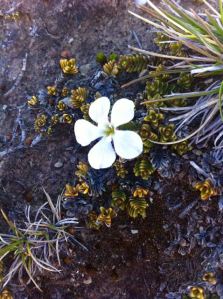
Higher up in the windy saddle where Feldmark environs exist you can see its smaller relative the Feldmark Eyebright (Euphrasia collina subsp. lapidosa). It is here in this windy exposed and bare site that one can see the micro magnificent Feldmark Snow-hebe (Chionohebe densifolia). Considering the soil paucity, micro climate and exposure, this plant in full bloom has to be seen to be believed! Clusters of dainty purple flowers exploding seemingly, from the ground. Leaves so small, tough and perfectly symmetrical, exhibit the characteristic dieback- regeneration of the Feldmark inhabitants. Among the margins of the feldmark a burst of yellow announces another Ranunculus species the Feldmark Ranunculus (Ranunculus acrophilus). If you get lucky you may stumble upon the lovely Granite Buttercup (Ranunculus graniticola), they seem to always have a granite pebble very close. The largest flower display by far is the Daisy (Asteraceae) family. It is still about a month early for a carpet of daisies nodding in the breeze but you can spot the early bloomers of the Herbfield Celmisia (Celmisia costiniana) and the Creeping Daisy (Brachyscome sp.(aff tadgellii). They grow happily along the path as you wind toward Blue Lake. The Alpine Lakes catchments offer a wealth of diversity. The hills leading toward Blue Lake are a perfect place to spot the newly blooming Ovate Phebalium (Phebalium ovatifolium) and look out for Daisies starting here too. As you walk along the flanks of Blue Lake be sure to keep an appreciative eye out for the Endemic Ribbony Grass (Chionochloa frigida) even when not in flower it is a lovely flowing tussock. If you have an eye for the micro flowers you won’t want to miss the Native Caraways (Oreomyrrhis sp.) which are flowering now (sheltered rock crevices are perfect habitat). The much larger Mountain Celery (Acyphylla glacialis) is in very early stages of flower.
My favourite bloom this walk went to the ever so fragile yet glorious, Alpine Caledinia (Caledinia alpina). This lovely orchid stands tall with its solitary leaf and often solitary bloom, like a little soldier bearing happiness, ready to bring a smile to the face of any whom have the tenacity to witness it.
So, with your face to the wind and the flies on your back, I wish you all happy wanderings.
Marion.


 alpinebloom.me
That’s fantastic dude!!! I love native flora.
LikeLike
What a great initiative! Well done Marion.
LikeLike
Love it!!!
LikeLike